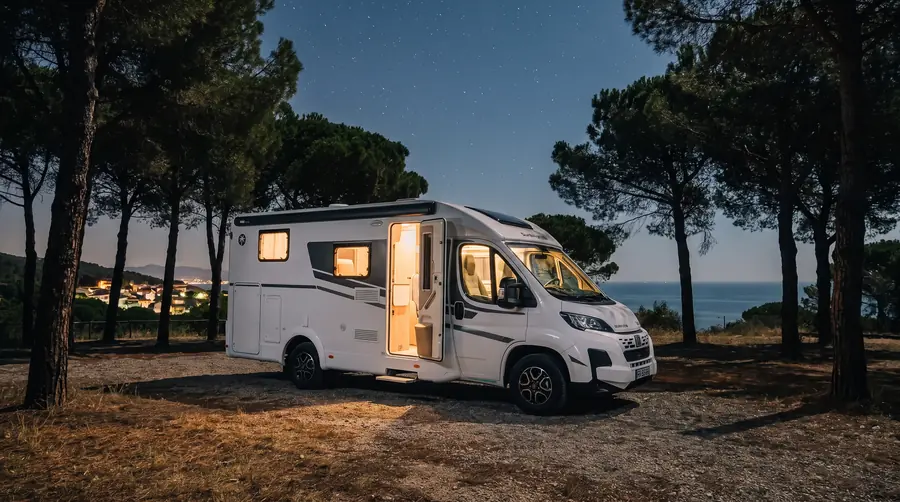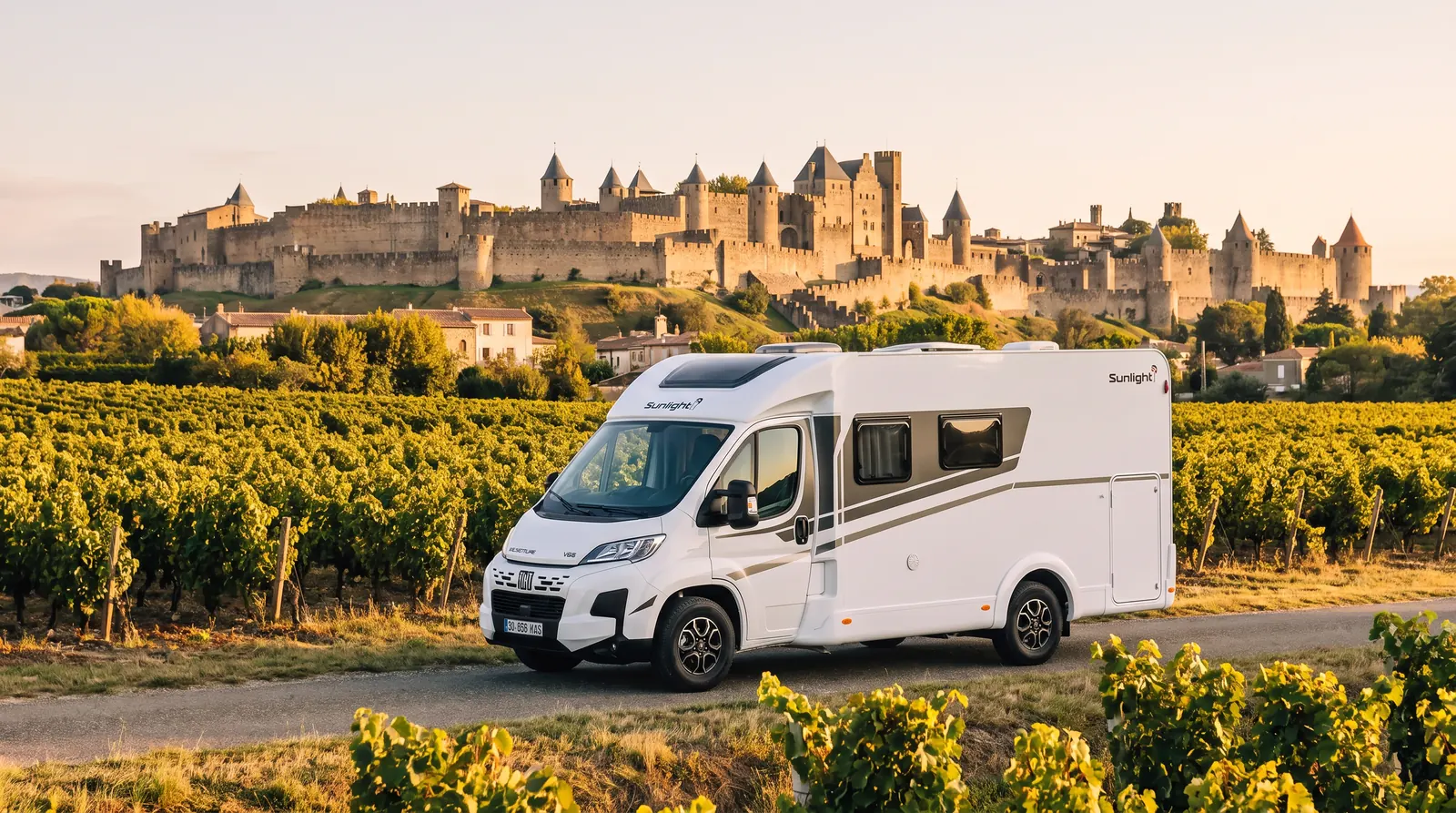
Cathar Country is the name given to much of the Aude department in Occitanie. In the 13th century it was the stage for the crusade against the Cathars, and that era left castles perched on rocky ridges, walled cities and abbeys surrounded by the vineyards of Corbières and Minervois.
From our base near Granollers you reach the border in 1 h 15 on the AP-7, and in about two and a half hours you are at the foot of the first castles. As pick-ups are in the afternoon, the 5-day plan (five nights) starts with a night near the border and ends with the return on the morning of day 6. After that the stages are short, and many French towns and villages have their own motorhome areas.
Route plan
Route map
Tap a day or a stop to see it on the map, or press "Follow the route" to travel it stage by stage.
Approximate line between stops, not a navigation itinerary. Check road conditions and restrictions for large vehicles before you set off.
What you will see
Day-by-day itinerary
Day 1 · Pick-up and a first night near the border
You collect the motorhome in the afternoon, between 16:00 and 19:00. Take the AP-7 north and in just over an hour you are in the Alt Empordà, right by the border. Spend the night at a campsite or authorised area nearby: you then cross into France rested in the morning and reach the castles with the whole day ahead of you.
Day 2 · Quéribus and Peyrepertuse
Cross at La Jonquera and continue on the French A9 motorway. After Perpignan, take the road up the Agly valley towards Maury, through the vineyards. Quéribus castle, on a rocky peak at over 700 metres, was the last Cathar stronghold to fall, in 1255; from the car park it is a short but steep walk up, with views of the Canigó and the Pyrenees from the top. In the afternoon, a few kilometres away, Peyrepertuse stretches along a ridge some 300 metres long above Duilhac-sous-Peyrepertuse. The site may close in very strong wind.
Day 3 · Lagrasse and Carcassonne
Cross the Corbières to Lagrasse, listed among the "most beautiful villages of France", with its medieval abbey beside the river Orbieu, its old bridge and the covered market hall in the square. In the afternoon, carry on to Carcassonne and start with the lower town: the Bastide Saint-Louis is easy to explore on foot, and the Canal du Midi, a World Heritage Site, runs close by. Sleep on the outskirts so you can walk up to the Cité early.
Day 4 · The Cité of Carcassonne and Minerve
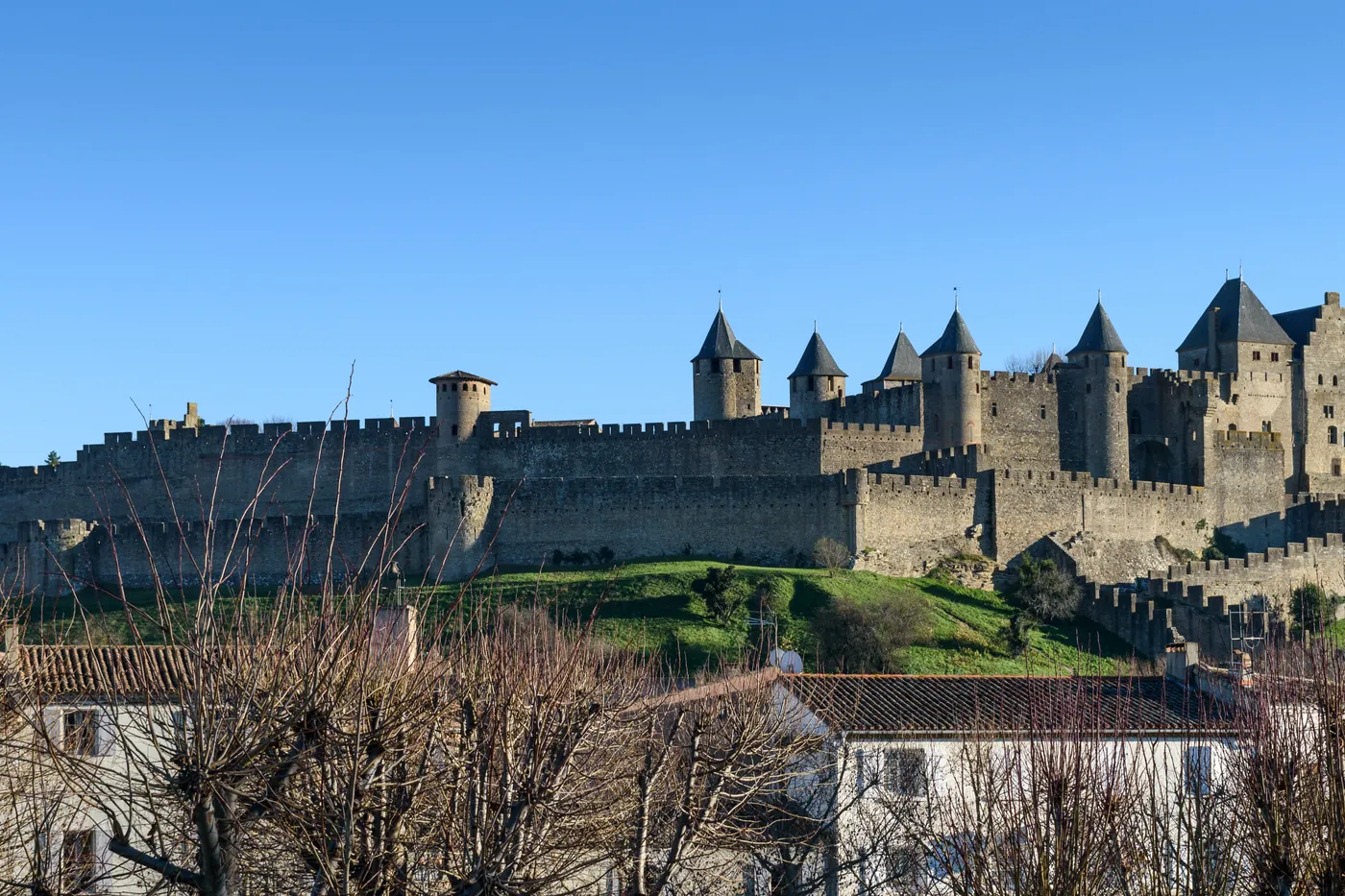
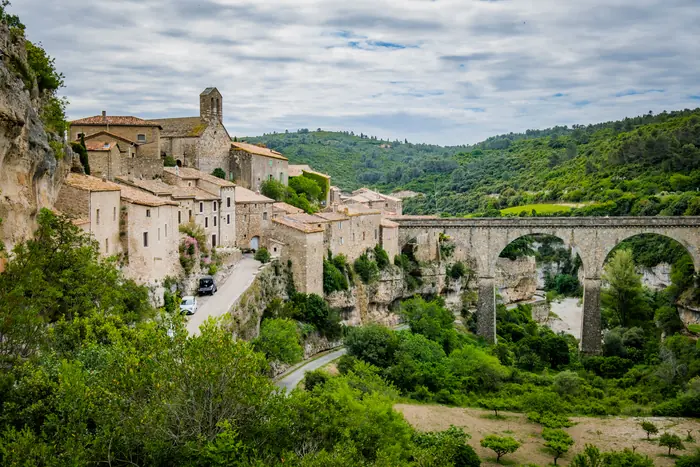
The Cité of Carcassonne, a UNESCO World Heritage Site, is one of the largest walled cities in Europe: two rings of ramparts with more than fifty towers, restored in the 19th century by Viollet-le-Duc. Motorhomes cannot drive in; leave yours in an outlying car park that accepts motorhomes and walk up first thing. In the afternoon, heading north-east, Minerve sits on a rocky spur between the gorges of the Cesse and the Brian. In 1210 it withstood a siege by Simon de Montfort, after which more than a hundred Cathars were burned at the stake. Park outside and explore on foot.
Day 5 · Narbonne and back towards the border
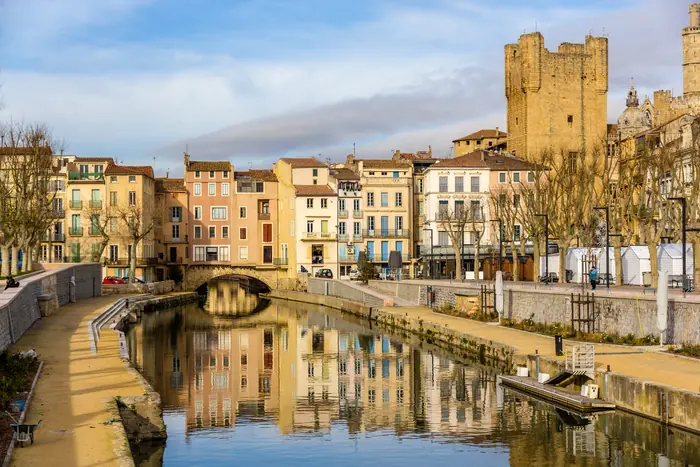
Narbonne was one of the first Roman colonies outside Italy, and in the town hall square you can see an original section of the Via Domitia. Next door stand the Archbishops' Palace and the cathedral of Saint-Just-et-Saint-Pasteur, never finished but with a soaring Gothic choir. From Narbonne to Granollers it is about 235 km and around 2 h 30 on the A9 and AP-7: cover most of it this afternoon and spend the night in Roussillon or the Alt Empordà. From the border area, on the morning of day 6 it is roughly an hour and a quarter on the AP-7 to the return, between 9:00 and 12:00.
Where to sleep
France is one of the easiest countries to tour by motorhome: many municipalities have their own area (aire de camping-car), often with water and waste disposal, and there are campsites throughout the region. In July and August, especially around Carcassonne, book ahead or arrive early. Apps such as Park4Night or Campercontact help you find them and read recent reviews.
Parking and overnight rules are set by each municipality, so respect the signs and any height or time limits. The common-sense rule is the same as in Spain: parking is not camping. Do not put out the awning, tables or levelling ramps except at campsites and areas that allow it, and empty waste water only at designated points.
Where to sleep with a motorhome in Catalonia
Practical tips
- Before you go: tell us you are travelling to France before pick-up so we can confirm insurance cover. Carry your ID card or passport and driving licence.
- Tolls: the A9 and A61 are toll motorways. Because of its height, the motorhome usually pays as class 2, a little more than a car.
- Old towns: neither the Cité of Carcassonne, Lagrasse nor Minerve is suitable for a 6.66 m motorhome. Park outside and walk in.
- When to go: July and August are very hot and crowded; spring and early autumn, during the grape harvest, are ideal. The wind (the tramontane or the cers) can blow hard, so take care with the awning.
- Mileage: the route covers about 620 km. A 5-day rental with Segimon Rental comes with unlimited mileage, leaving room for detours to Fontfroide Abbey or Montségur.
Frequently asked questions
How many days do I need for Cathar Country by motorhome?
Five days, as in this plan (pick-up on the afternoon of day 1, return on the morning of day 6), cover the highlights without rushing. With 6 or 7 you can add Montségur, Fontfroide Abbey or a lazy day by the Canal du Midi; from 5 days, mileage is unlimited. To carry on to the coast and the Camargue, see our south of France route.
Where can I sleep with a motorhome in Cathar Country?
At municipal motorhome areas (aires de camping-car), which are very common in France, or at campsites. Respect each municipality's signs.
Do I need a special licence to drive the motorhome in France?
No: at 3,500 kg a standard car licence (category B) is enough. Just let us know before pick-up so we can take it into account for the insurance.