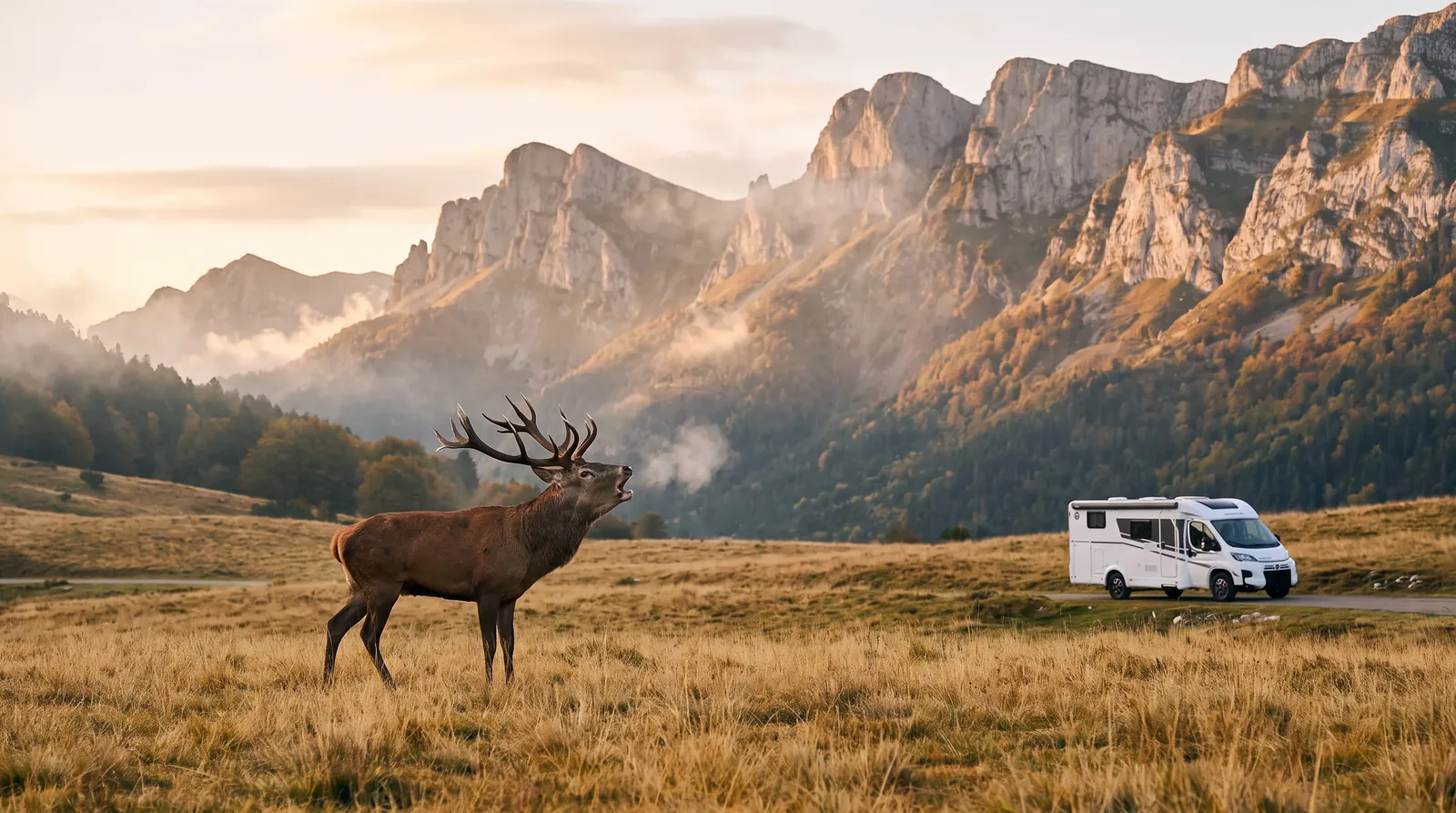
Every autumn, the forests of the Boumort National Game Reserve, in the Pallars Jussà, fill with roaring: stags mark their territory and gather their hinds. This is the rut, one of the most powerful wildlife spectacles in the Pyrenees, and it is best experienced at dawn or dusk, in silence and with a guide. This route uses La Pobla de Segur as a base and adds the Conca Dellà, Tremp, Collegats and Gerri de la Sal.
It is a four-day rental, four nights: you collect the motorhome on the afternoon of day 1 and return it on the morning of day 5. The rut usually runs from mid-September to mid-October, peaking in late September and early October; that is mid season, with a 4-day minimum. For more mountain wildlife, see our Pyrenees wildlife route.
Route plan
Route map
Tap a day or a stop to see it on the map, or press "Follow the route" to travel it stage by stage.
Approximate line between stops, not a navigation itinerary. Check road conditions and restrictions for large vehicles before you set off.
Day-by-day itinerary
Day 1 · Pick-up and drive to Isona
You collect the motorhome between 16:00 and 19:00 in Les Franqueses del Vallès and take the Eix Transversal westwards. Via Ponts you climb into the Conca Dellà: just over two hours to Isona, a leg best driven while there is still light. Spend the night at a campsite or authorised area nearby and have dinner ready: from tomorrow you follow wildlife hours, early mornings and late evenings.
Day 2 · Isona, Tremp and La Pobla de Segur
In the morning, visit the Museu de la Conca Dellà in Isona, with Cretaceous dinosaur remains and finds from the Roman town of Aeso. Carry on to Tremp, capital of the Pallars Jussà, in the heart of the Orígens Geopark, and up to La Pobla de Segur, your base for Boumort. In the late afternoon, a listening outing with an authorised company takes you to viewpoints inside the reserve along tracks that need a 4x4. The roaring usually builds as the sun sets.
Day 3 · Collegats, Gerri de la Sal and dawn in Boumort
If you did not go out yesterday, book the dawn outing: the cold, the mist in the valleys and the first roars are worth the early start. Then the Collegats gorge, where the Noguera Pallaresa cuts between rock walls; the old road is now a walking route. Further up, Gerri de la Sal keeps its salt pans and the Romanesque monastery of Santa Maria. Sleep again in La Pobla or Tremp.
Day 4 · Solsona and Cardona
Leave the Pallars via Tremp and Isona and cross to Solsona, with its cathedral and an old town made for strolling. Mid-afternoon, Cardona: the castle towers over the town and the Salt Mountain is a unique geological landscape with guided tours. Sleeping here leaves just over an hour's drive home: on the morning of day 5 you reach the Vallès in good time for the return between 9:00 and 12:00. With an extra day, the Mont-rebei gorge lies south of Tremp; see our Pallars and Montsec route.
Where to sleep
Tremp, La Pobla de Segur, Isona and Cardona have campsites, and some villages have authorised motorhome areas. On rut weekends the area gets busy: book your campsite and, above all, your guided outing well ahead. Park4Night or Campercontact help you find areas and water points.
You may park wherever any vehicle may park, as long as you are not camping: no awning, chairs or levelling chocks, and no emptying of waste water. Wild camping is not permitted in Catalonia. The Boumort tracks need a 4x4: never take the motorhome onto forest tracks or sleep inside the reserve.
Where to sleep with a motorhome in Catalonia
Practical tips
- Silence and distance: whisper, stay at the viewing point and use binoculars. If a stag stops roaring or moves off because of you, you are too close.
- No lights at night: never shine torches or headlights at the animals, and switch off your flash.
- Do not call the deer by imitating roars or using lures: it disrupts their behaviour at the most sensitive time of year.
- Bring warm layers: dawn in the Pre-Pyrenees can be cold even after a mild afternoon. The V66's Truma heating is welcome when you get back.
- The route covers about 580 km in four days: with the 300 km a day included in Segimon Rental's 3 to 6-day rentals, you have plenty of margin.
Frequently asked questions
When is the red deer rut in Boumort?
Usually from mid-September to mid-October, peaking in late September and early October. It depends on each year's weather: check with the guided-outing companies before fixing dates.
Can you drive a motorhome into the Boumort reserve?
It is not a good idea and not what the tracks are for: they require a 4x4. The best option is a guided outing with an authorised company, which picks you up in town and takes you to the listening points.
How many days do you need for the deer rut by motorhome?
Four, as here, which is also the mid-season minimum (September and October). That gives you two chances, dusk and dawn, in case one is rained or misted out.
Where to sleep for the Boumort deer rut?
At campsites or authorised areas in La Pobla de Segur or Tremp, close to the meeting points for guided outings. Book early for peak weekends.